Finding
Adi Da > Chris Tong > Part I (Finding the Divine in Person) > Chapter 21
Finding
Adi Da > Chris Tong > Part I (Finding the Divine in Person) > Chapter 21
21. Working With Adi Da and the Lay Renunciate Order
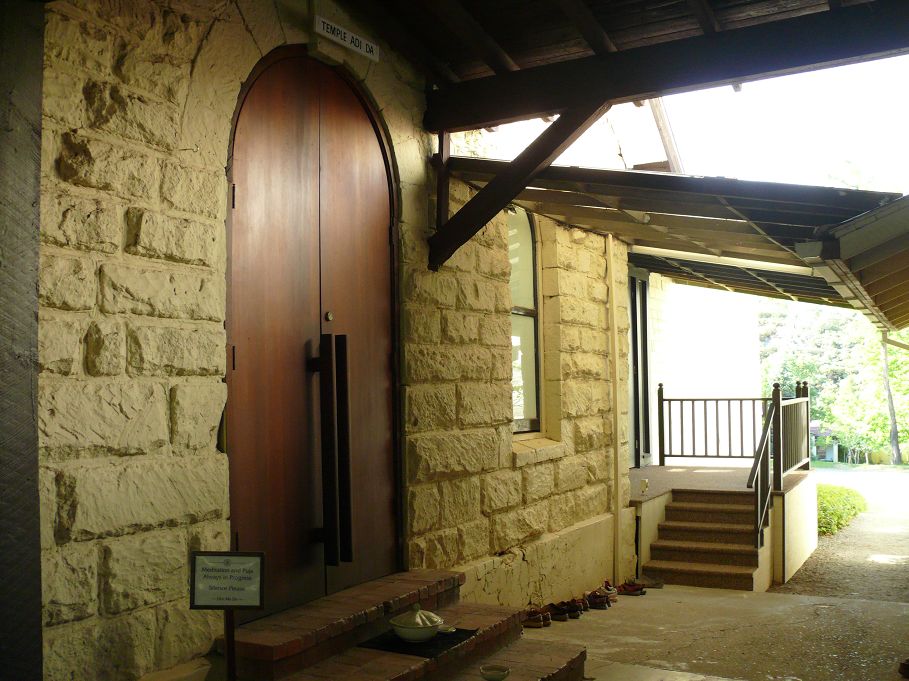
Temple Adi Da (the near doors) and Plain Talk Chapel (the steps further back) at the Mountain Of Attention Sanctuary (click to enlarge) |
|
|
| This is part I, chapter 21 of Chris Tong's story, Finding the Divine in Person and Waking Up From the Dream. | |
|
|
In late 1994, Adi Da sent Notes to me and my fellow devotee, Ed Rahsman. At the time, Ed and I were both serving Adi Da’s Work while living at the Mountain Of Attention. In His Notes, Adi Da said that He felt we were two of His strongest devotees, and, for that reason, He was making us the co-heads of His Lay Renunciate Order (aka "the LRO"):
All should cultivate this relationship to Me, and the sadhana in which I interact with people is the sadhana done in the fullest sense. I also want people to come here from time to time who are on fire, like individuals who I feel in the worldwide gathering, such as Chris Tong and Ed Rahsman, for they feel to Me to be on fire. So they should come from time to time, but they should not be undermined by the bland worldliness out there. And they should not let it take them over. And they should not let the culture be suppressed in terms of its practice of Ishta-Guru-Bhakti Yoga. That's the point of why the LRO should come here with some frequency. Individuals should come who are truly prepared. That is the point.
Chris Tong and Ed should understand that this is the quality that I want around Me, and they should not allow people to be suppressed in any sense. This is what the LRO message is to all practitioners.
Then people who are responsive to Me should be brought to Me. And if they are not responsive to Me in this manner, they should get on the boat, for I do not want to live that way anymore. I am not interested in polite social relations. . . Get me some women and get me some men who are alive with Me and who can find a way to relate to Me directly, who can live in My Face, who can get the taste of Me, and who are up to level 2, people who are not afraid to live around Me.
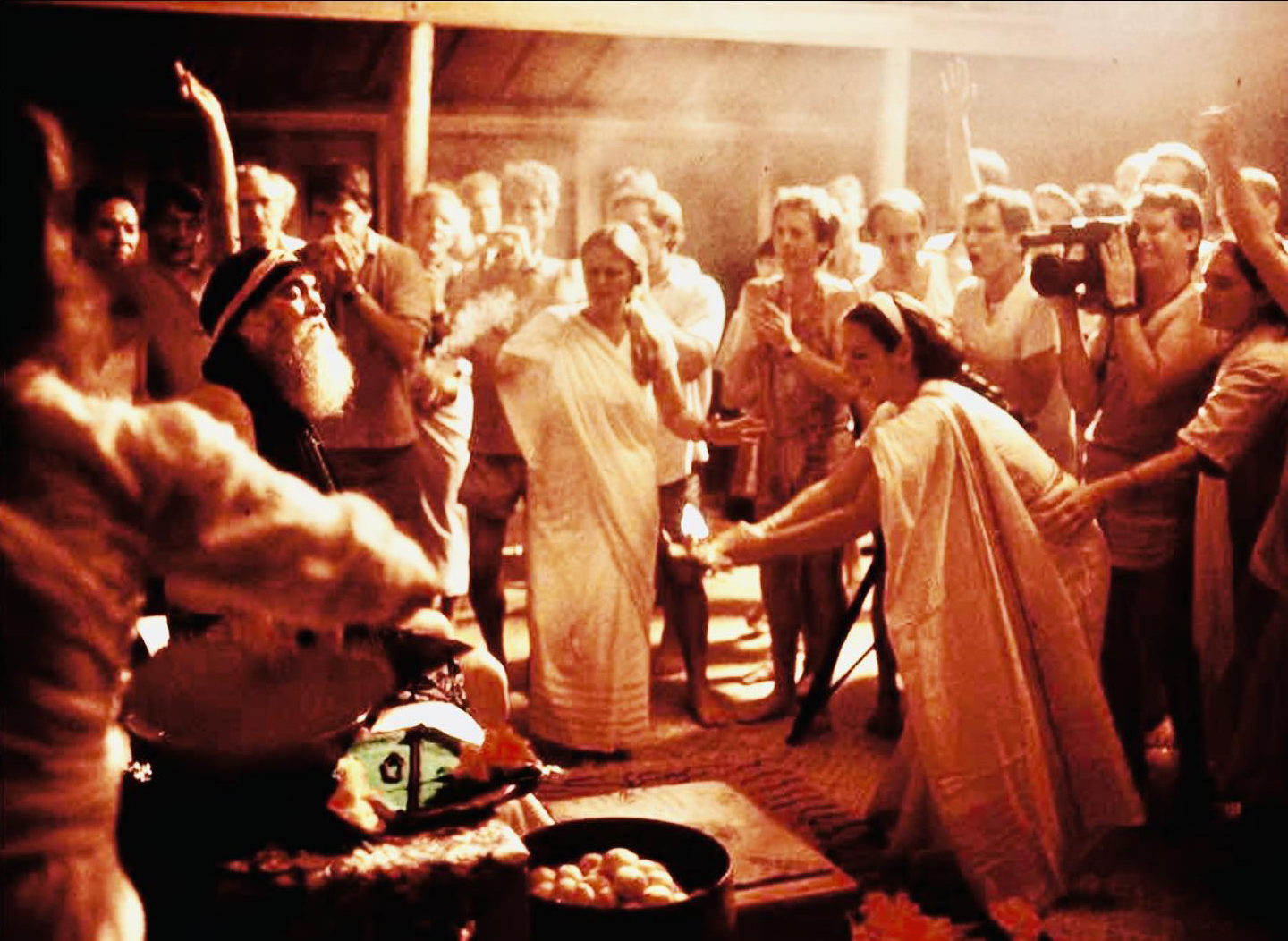 Darshan with Adi Da. Ed Rahsman is the devotee with his mouth open, just to the right of the cameraman. (Click image to enlarge) |
This function involved much more than managerial tasks! What I recall most about engaging this service was the intimate way we worked with Adi Da to help Him develop the practice of the Way of Adidam. The devotees in the Lay Renunciate Order were those devotees with the greatest response, willing to engage the practice of Adidam most intensively. So Adi Da would “experiment” with ways to intensify the practice of Adidam for LRO members. He would have Ed and I try out His proposals ourselves, and dialogue with Him about the results, before He would pass them on to the full Lay Renunciate Order.
We engaged in many such “practice experiments” for Adi Da! And we were delighted when some of them were successful, and Adi Da would then have the entire LRO adopt them.
Here’s just one example of a practice experiment. One week, Adi Da had Ed and I experiment with four-hour morning meditation periods. Normally, morning meditation is an hour and a half. So four hours is a much longer period! But Ed and I were always eager to test out any of Adi Da's ideas, because of their potential for accelerating devotee growth. So we entered a small Communion Hall (Plain Talk Chapel) at the Mountain Of Attention Sanctuary and sat for four hours. Ed and I emerged into the light of day, four hours later. I looked at Ed. Ed looked at me. I shook my head, saying, “nah”. He laughed and agreed. The extra time in meditation had not made any noticeable difference for either of us.
Working in such a way with Adi Da to develop the practice of Adidam felt very intimate! And both Ed and I also felt it to be an incredible responsibility that we needed to “get right” — we needed to be 100% sure not to report conclusions that might be inaccurate. So despite our initial negative impression, we continued the four-hour morning meditations for a full week, in order to be able to give Adi Da a conclusive report on it. This report would then be able to describe what difference a four-hour meditation might make not just on one’s immediate state leaving the Communion Hall, but also whether the added time in meditation would help with one’s practice throughout the rest of the day. The morning meditation and puja are intended to be the way we start the day; they serve as the devotional foundation for the rest of the day. Those events of meditation and puja allow for the greatest depth during the day because there is nothing else competing for our attention while we are sitting in the Communion Hall. Then we bring that depth of practice into the rest of the day, where many other things now are competing for our attention, and we work to sustain that early morning depth of practice. In principle, a longer meditation could be a resource that makes practice during the rest of the day easier; however, our continued experimentation the rest of that week did not bear this out.
From the beginning of His Work with devotees, Adi Da had engaged in experimentation with different forms of the practice. He knew what had worked for Him in His Own process of Re-Awakening to Divine Realization. But He soon learned that many things He was capable of doing were impossible for all the devotees who had come to Him, to date. (He did always consider the possibility that there could be exceptional devotees in the future capable of doing aspects of the practice no devotee so far had been able to do.) So it was important to "test out" all aspects of the practice on actual devotees. Sometimes the experiments He did involved the entire culture of devotees. We tried out many different dietary regimens over the years, for example. But in this case where He was experimenting with Ed and me, His experiments were more nuanced. He knew what He was proposing probably would not be useful for the general gathering of devotees. But He was wanting to learn whether there were some devotees who could make use of a particular variation in practice, and that’s where we (and the entire LRO) came in.
After years of experimentation, Adi Da's conclusions about what forms and stages the practice of Adidam might take (and which forms and stages were appropriate for which people) were summarized in His Source Texts, including The Dawn Horse Testament and The Aletheon.