Finding
Adi Da > Chris Tong > Part IV (Waking Up) > C (Further Elements) > Chapter 5
Finding
Adi Da > Chris Tong > Part IV (Waking Up) > C (Further Elements) > Chapter 5
5. Turning Every Moment into Divine Communion

|
|
| This is Part IV-C, Chapter 5 of Chris Tong's book, Finding the Divine In Person and Waking Up From the Dream. | |
|
|
When Adi Da would gather with His devotees on Naitauba in Hymns To Me, He often would make some part of the gathering be a dance gathering. He might start an evening by talking to us extensively about some subject; but then He'd end the evening by having everybody dance. (And occasionally, the entire evening would be dancing.) Our DJ, instructed by Adi Da, would usually choose upbeat, energetic pop songs, often ones whose lyrics were capable of being interpreted in terms of the Guru-devotee relationship — examples of some favorite, often replayed songs were Steve Winwood's Higher Love, Huey Lewis's The Power Of Love, and the Police's Every Breath You Take. Adi Da would sit in His chair at the center of one side of the hall, lovingly watching all His devotees ("Every breath you take, I'll be watching you"), and we'd be dancing to the music with each other in the rest of the room while we contemplated Him.
Sometimes, I would sit down next to His chair, and simply contemplate Him. It was so much easier to feel Him, and be in Divine Communion with Him like that! Of course, regardless of where His attention appeared to be, He was completely aware of my sitting there, but would often indulge my sitting there for a while. Sooner or later, however, He would turn to me, often with a smile, and then make a gesture with His right index finger pointed downward. He'd move it through the air as though He were using it to stir a drink — He was using His finger to symbolize dancing, and He was instructing me to get back to it. And so I would, re-energized from having sat with Him.
The point of this story is that, in the practice of Adidam, we need to discover how to be in Divine Communion with Adi Da in every moment of the day, no matter what we are doing. And in this moment it was: how to dance and interact with other devotees, and still be in Divine Communion with Him.
The Secret is to always remain in devotional Communion with Me. You have different kinds of functions and obligations and all the rest of it. Therefore, you must live the practice of Adidam to such a degree that you are able to be in devotional Communion with Me no matter what you are doing — no matter what kind of activity, function, or whatever, is happening at the moment. Therefore, the complexities of right practice are about how you conform every kind of function and moment to devotional Communion with Me.
It is a simple thing that is always being done, but you are required to adapt to all different kinds of particularities. It is the particularities that make the simplicity seem complex. In this moment, you have some requirement to do something or other. You can either do that, just merely as it is, or you can have it be devotional Communion with Me, true service to Me. What do you have to do to your action in any moment to have it be true devotional service to Me, to have it be such Communion with Me? That is what you must “consider”. You must intelligently “consider” every detail, every aspect of your life, and decide what you must do relative to each kind of function, relationship, and all the rest of it, such that you are always transcending egoity, always devotionally Communing with Me.
That is another aspect of what I Intend to Communicate when I Say that you must, in the beginning, find out what it is to be Reality-intelligent. This is how to function intelligently: As a practitioner of Adidam, you must require every aspect of your life to be a form of devotional Communion with Me. That does not mean you stop doing everything and just stay in your room to Commune with Me. It is more complex than that — because, even if you did go and sit in your room, you would still be haunted by yourself. Therefore, you must do the practice of Adidam relative to all of the aspects of your life. You must practice with them. You must adapt everything to the Divine Process — not adapt the Divine to them, not subordinate the Divine to them, but subordinate all aspects of your life to the Divine.
By natural necessity, you are active in all kinds of ways. You must find out how each of those kinds of action can be true service to Me, devotional Communion with Me. How do you do it with work? How do you do it with lunch? How do you do it with sex? How do you do it with social relations? How do you do it with everything? This is what I have “Considered” with people since I first began to Teach.
You live all the time as if you are somehow under the worst of circumstances. You will not allow yourself to release the “self”-contraction and enter into Divine Communion, whole bodily, because you are aware that there are circumstances under which you would not be able to do so. You must discover that there is no circumstance under which you are incapable of entering into Divine Communion. Whatever you must do in order to get to that point of certainty is what you must do. Everyone must do that. It is not necessary to suffer mightily in order to discover this. But you must be able to somehow get in touch with your psychological limits. You must be tested.
Practice While Sleeping Reduces self-Contraction. Moment-to-moment" practice of the Way of Adidam means twenty-four hours a day! So what about when one is sleeping?
I realized this was a serious matter when my daytime practice had become much closer to a moment-to-moment practice. But every now and then, I'd wake up in the morning completely contracted, because of all that sleep time when I was not practicing — and the contrast between the daytime state, largely free of contraction, and this state after waking up was startling. It wasn't bad every morning. As Adi Da has observed (as we mentioned in the chapter on the self-contraction), the self-contraction has a natural cycle or rhythm. But when that cycle was on the downward phase, the morning contraction could be quite severe.
The primary purpose of Adidam devotional groups is to identify "lapses" in each devotee's practice of Divine Communion, and take on disciplines that will address those lapses. Adi Da used the word, "lapses", because the presumed context is devotees whose practice is ever more moment-to-moment; then the devotional group would help "plug" any remaining holes, to make practice truly moment-to-moment, covering "the whole guy". The basic "right life" disciplines, practiced by all devotees, are intended to establish a practice in which there no big holes (of hours at a time — let alone days, weeks, or months!) in one's practice timeline. And then the individual devotee, aided by one's devotional group, adds disciplines that are fine-tuned to that particular devotee, to eliminate the remaining "lapses" (generally, lapses of minutes at a time).
But with sleep, we are talking about a "lapse" of 6-9 hours each day, for virtually every devotee!
You must discover that there is no circumstance under which you are incapable of entering into Divine Communion.
So I engaged the Devotional Prayer of Changes to provide a form of practice that could compensate for or even eliminate the huge lapse in practice that was occuring while asleep.
A couple of nights later, I found myself practicing while I was dreaming. I don’t recall the details of the dream, but I do recall practicing in the midst of it.
Another couple of nights later, I woke up with Adi Da pouring Love-Bliss down the entirety of the body, from my head all the way down to the toes. This went on for hours, as I'd alternate between engaging in Communion with Him while awake, and then letting Him continue the process while I was asleep. The good thing about our practice being a relationship, and not merely a technique, is that either partner in the relationship can take the initiative! And this was one of the moments where Adi Da was initiating. What I needed to know was how to "grasp the tail of the Horse" and let the Horse take me, while I'm sleeping. And what was demonstrated that night was that being in a powerful state of Divine Communion when I fall asleep is a good way to "grasp the tail of the Horse".
So I began a practice of falling asleep in Divine Communion, and then entering into Divine Communion (or maintaining Divine Communion) whenever I woke up at night. And this practice immediately began bearing fruit when I would wake up in the morning: most of the time, I'd feel much less contracted, or not contracted at all and already in Divine Communion.
Because some readers find graphs useful in understanding something, I've put together three graphs, showing a two-day period, and reflecting different degrees of practice. (Everyone else can just jump down past the graphs to the next section!)[4]
The first graph reflects a common devotee pattern of practice, where Adi Da's Divine State (displayed as "degree of Happiness") is largely felt only during morning meditation:
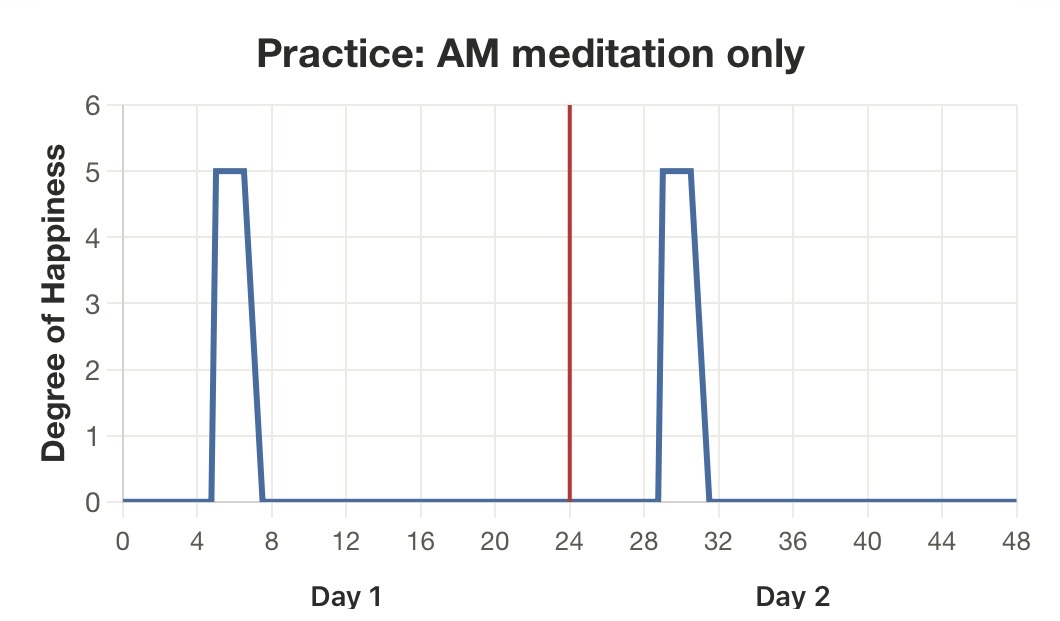
You can see how devotees with this degree of practice wouldn't particularly notice anything different when they wake up in the morning, because it simply is a continuation of the contracted state they were in when they went to sleep.
The second graph reflects a practice where Adi Da's Divine State is felt most intensely during morning and evening meditation, but then is also felt throughout the day — but not at night.
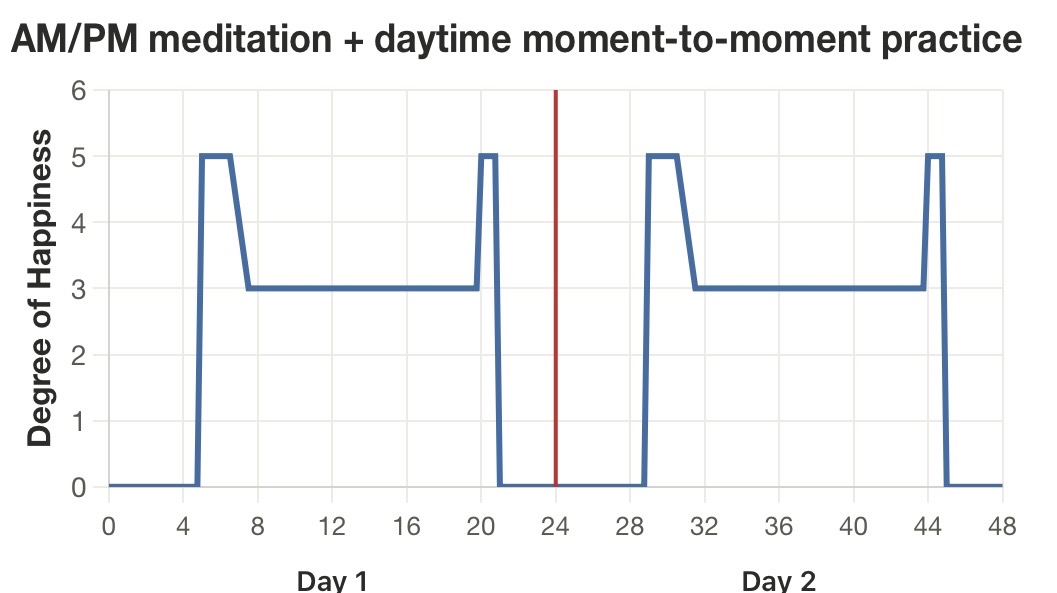
The third graph reflects a practice where Adi Da's Divine State is felt most intensely during AM and PM meditation, but then is also felt throughout the day, and to a lesser degree while asleep.
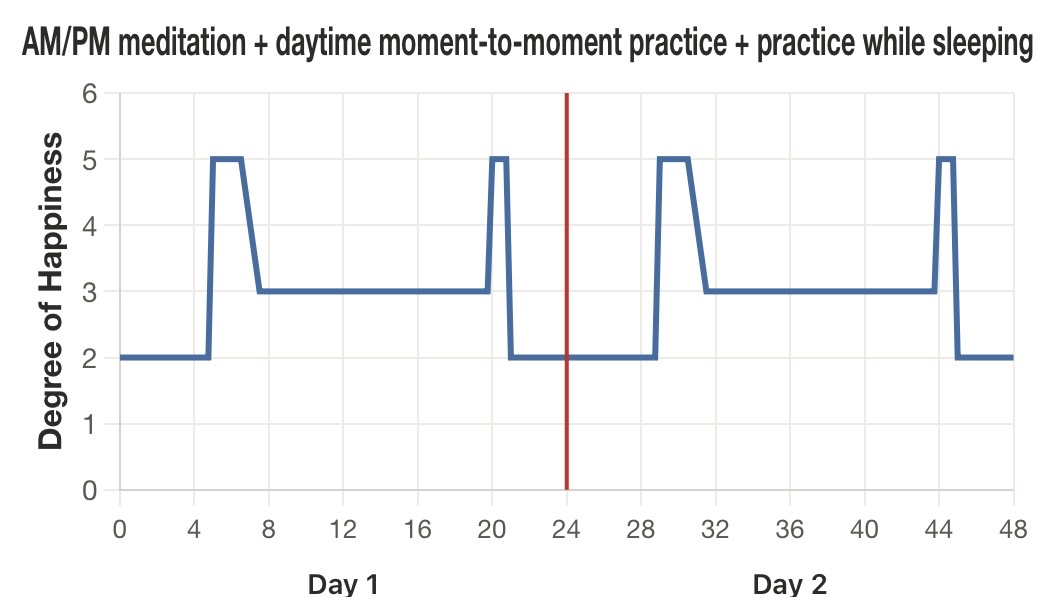
Dreams Begin to Reflect Practice Rather than Egoity. Another indicator — of moment-to-moment practice throughout the day and at night — is that the content of one’s dreams starts to change. . . from random egoic content (often reflecting the issues of the day or longer term psychic issues, and sometimes taking the form of nightmares) to content that is reflecting the shift in where one is placing one’s attention and feeling: on Adi Da rather than on self. This is important not only as an indicator of progress in self-transcendence, but as a predictor of the kind of after-life experiences one will have — since the after-life bardos are largely generated by the very same mind that is generating one's dreams at night while one is alive.
So for example, two nights ago, in the midst of sleeping, I was practicing immersing the whole body in Adi Da’s Divine State, as I would go in and out of sleep. At one point during this multi-hour process, I had a dream:
I dreamed I was near Adi Da’s residence, probably on the island of Naitauba. A number of devotees were gathered there, awaiting Adi Da’s appearance. I found a place to sit, and as it turned out, I was sitting right next to Naamleela, Adi Da’s daughter.
Beloved Adi Da appeared, a few feet in front of us. After a while, He looked over. He seemed to take delight in finding Naamleela and I seated together — He had a big smile on His face, and then He suddenly had an iPad in His hands, which He used to take a picture of us.
Then He walked over to us and placed the iPad over both our heads. The iPad somehow grew to an enormous size, and it also somehow became a folding version of an iPad, where the screen side came down in front of our bodies, and the other side was behind us. Adi Da then used this like a gigantic (but also very comfortable) pair of tongs. He picked us up with it, and then started whirling us around Him, like planets around the Sun. I was incredibly Happy! I let my feet hang out in the air, and just enjoyed the ride as He whirled us around. At some point, I woke up. I could feel my entire body still immersed in His Divine Happiness.
And then last night, while doing the same practice of Divine Communion, I had this dream:
I was walking into an office with a woman I did not recognize. She accidentally dropped a piece of cream cheese on the floor of the office. I immediately went to clean it up.
But before I could get to it, Adi Da walked in, dressed in a sheriff's outfit, wearing a cowboy hat, cowboy boots, and a silver sheriff's badge in the shape of a five-pointed star.[1] His right foot slipped on the cream cheese and was twisted for a moment, causing Him to grimace before He straightened out His foot.
I finished cleaning up the cream cheese.
Adi Da then looked at us both. "What are you going to do about this?"
I told Adi Da I had cleaned up the cheese. He said that was good, and then turned to the woman.
"What about you?" She apparently understood that Adi Da would need to take her through a further consideration, and so she walked out of the office with Him.
Having had dreams like this before, I immediately understood the symbology of the dream.
The "office" was the symbol of a formal, orderly place — in the context of the practice of Adidam, that meant: a sacred place, that has associated spiritual rules (including all the "right life" disciplines of the Way of Adidam):
When you step into a sacred place, you must have things in order at the door before you enter. If you throw your shoes all over the place, you are not being sufficiently aware — you are not respecting the place that you are about to enter.
Therefore, if you throw your shoes around at the door to My Domain, I will simply Say to you, “Shoes are not in order. You cannot come in here. No way — your shoes are not in order.” To have your shoes in order is a requirement. In other words, you must be aware not only of what you do once you are in My Domain, but also of what you do to get through the door.
Adi Da's "slip" was actually referring to a "slip" in an aspect of my own practice. That the dream was portraying it as His slip was a reminder that the Way of Adidam is all about the relationship with Him; any slip in my practice actually harmed our relationship, as reflected by the grimace on His Face. That I immediately went to "clean up" the "slip" in my practice as soon as I noticed it was a good thing.
The "woman I did not recognize", who was actually the one who "dropped the cream cheese on the floor" — i.e., the one who was actually responsible for the "slip" — was a part of me that I was only beginning to understand and master.[3] Her going off with Adi Da for a "further consideration" was the dream communicating that Adi Da worked directly with His devotees' deeper patterns — the ones the devotee was not fully conscious of yet — transforming them, bringing them to light, weakening them, allowing the devotee to consciously be the pattern (and by so doing, be in a position to "own" and release the pattern) rather than only being able to counter-egoically clean up the mess created by the pattern after the pattern had already done its thing (symbolized by me cleaning up the mess she had created).
I Work on the pattern that is prior to the pattern that seems, or the pattern that is concrete at the moment. I Work on the pattern that is invisible, prior, not yet observed. And then I Breathe it down into the world.
Finally — I understood the interchange with Adi Da in the dream:
ADI DA: What are you going to do about this?
CHRIS: I cleaned up the cheese.
ADI DA: Good.
to be not just a one-time exchange or "just a dream", but an agreement to take responsibility for this area of my practice from now on. I took that agreement very seriously. In effect, I was having a "devotional group" with Adi Da, and I was taking on a new discipline as part of the group meeting.[2]
Practice While Sleeping: An Ongoing Consideration. Dreams like these — that include Adi Da, the devotional relationship with Adi Da, or some aspect of practicing the Way of Adidam — are natural in the context of a moment-to-moment practice that is focused on Him. And, as was illustrated by the second dream, not only can you practice being in Divine Communion with Adi Da while sleeping; you can even have devotional groups and take on new disciplines while you are sleeping!
Of course, in order for dreams to be able to serve a purpose like this, you have to be able to remember your dreams — and before I began consciously practicing while sleeping, I seldom remembered my dreams. But the practice of consciously entering into (or maintaining) Divine Communion every time I woke up from sleep also has turned out to be a very good practice for becoming more conscious altogether at night — including remembering more of one's dreams. Here are some additional tools that may prove useful in each person's case:
- Keep a Dream Journal. Place a physical notebook or some means to record your voice right next to your bed. Write down every fragment, color, or fleeting emotion the instant you wake up, as memories vanish within minutes of waking.
- Set an Intention. Before falling asleep, engage the Devotional Prayer of Changes: "Tonight, I will remember my dreams."
- Reverse Engineer? If you wake up and cannot remember anything, start with how you feel. Ask yourself, "Do I feel anxious, peaceful, or confused?" Tracing those emotions backwards sometimes can unlocks the narrative of the dream.
MORE SECTIONS COMING
FOOTNOTES